Treasures shrouded in mystery, carefully preserved in the Imperial Treasury in Vienna, are faithfully reproduced on this remarkable coin. Symbols of the Divine most certainly deserves pride of place in your own personal treasury.
Like all the coins that follow, the first coin in the Myths, Treasures and Legends series draws on the priceless legacy of 600 years of Habsburg rule. Discover fascinating insights into the House of Austria and the religious and mythical worldviews that shaped it. Speaking of which, are you fascinated by the search for the Holy Grail?
The Blood of Christ
The coin brings together objects that beautifully unite the earthly and the divine. It depicts relics that, during the Middle Ages and beyond, were believed to have come into contact with the blood of Christ. In other words, it unites on a single coin the sacred objects associated with one of Christianity's defining moments, the Crucifixion. These relics arose from a longing to make faith tangible and find reassurance in Christ's love – a love that makes one invincible – and were regarded by the Habsburgs as a sign that God had ordained their authority.
The Holy Lance
The Holy Lance has been interpreted in various ways over the centuries. By the 13th century, it had come to be identified with the lance of the soldier Longinus, who is said to have inflicted Christ's fatal wound. Believed to have been stained with Christ's blood, the lance was long regarded as a symbol of imperial authority and ranked among the foremost Imperial Regalia. Its miraculous powers were even thought to have brought about victories in battle.
The Relics of the True Cross
Another relic associated with Christ's Passion is a collection of fragments of the True Cross dating from after 1350. They were believed to be stained with Christ's blood. The fragments recall Christ's devotion, his willingness to sacrifice himself and his boundless love. Those who possessed them were believed to be under Christ's own protection.
The Agate Bowl (The Holy Grail)
Around 1,600 years old and preserved in immaculate condition, the agate bowl was long believed to be the Holy Grail, the vessel that caught Christ's blood. It most likely reached the West following the capture of Constantinople in 1204. It was first recorded in writing in 1564, when the heirs of Emperor Ferdinand I declared it an "inalienable heirloom of the House of Austria".
Across the centuries, these precious testaments to Christian devotion have retained their aura of the divine.
The Coin Motifs
The obverse shows renowned Christian relics. The Holy Lance (8th-14th century) contains, at its centre, a metal pin believed to be one of the nails used to nail Christ to the Cross. Behind it are the Relics of the True Cross. According to tradition, they originate from Christ's Cross and are housed in a simple crucifix dating from after 1350. Behind them is the 4th-century agate bowl, carved – including handles – from a single block of stone. This extraordinary masterpiece was revered as the Holy Grail.
The reverse depicts the crucified Christ. Blood flowing from his side is caught in a bowl. To the left stands the soldier Longinus, holding the lance with which he is said to have inflicted the wound.
With the Myths, Treasures and Legends series, you can enrich your coin collection with exceptional, high-quality reproductions of the treasures preserved in the Imperial Treasury in Vienna.
| Product No. | 28218 |
| Date of Issue | 14 October 2026 |
| Quality | Proof |
| Series | Myths, Treasures and Legends |
| Face Value | 100 Euro |
| Diameter | 30.00 mm |
| Coin Design | Helmut Andexlinger |
| Alloy | Goud Au 986 |
| Fine Weight | 15.55 g / 0.50 oz |
| Total Weight | 15.78 g |
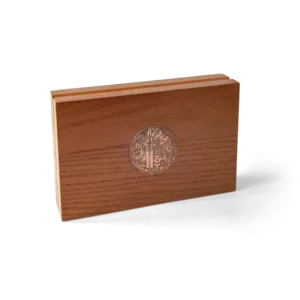
| Packaging | Comes in a case complete with a numbered certificate of authenticity and protective slipcase |
| Mintage (Proof) | 20,000 |
Legal notice regarding the suspension of the customer's right to return goods.
No right of return